MCP at 1.0: What Production Actually Looks Like in 2026
- Decide when MCP is the right primitive vs OpenAPI, LangChain tools, or raw API calls.
- Configure auth, progressive tool disclosure, and observability for a production MCP deployment.
- Identify the five most common MCP failure modes before they hit production.
Use MCP when you need one server implementation to serve multiple AI clients without rewriting connectors, and when the data source is live — not static. As of 2026, the spec is mature enough for production: Streamable HTTP handles load balancing, OAuth 2.1 is specified for auth, and 41% of surveyed engineering organizations are already in production or active pilots. The gap between the spec and most deployed servers is tooling, not protocol.
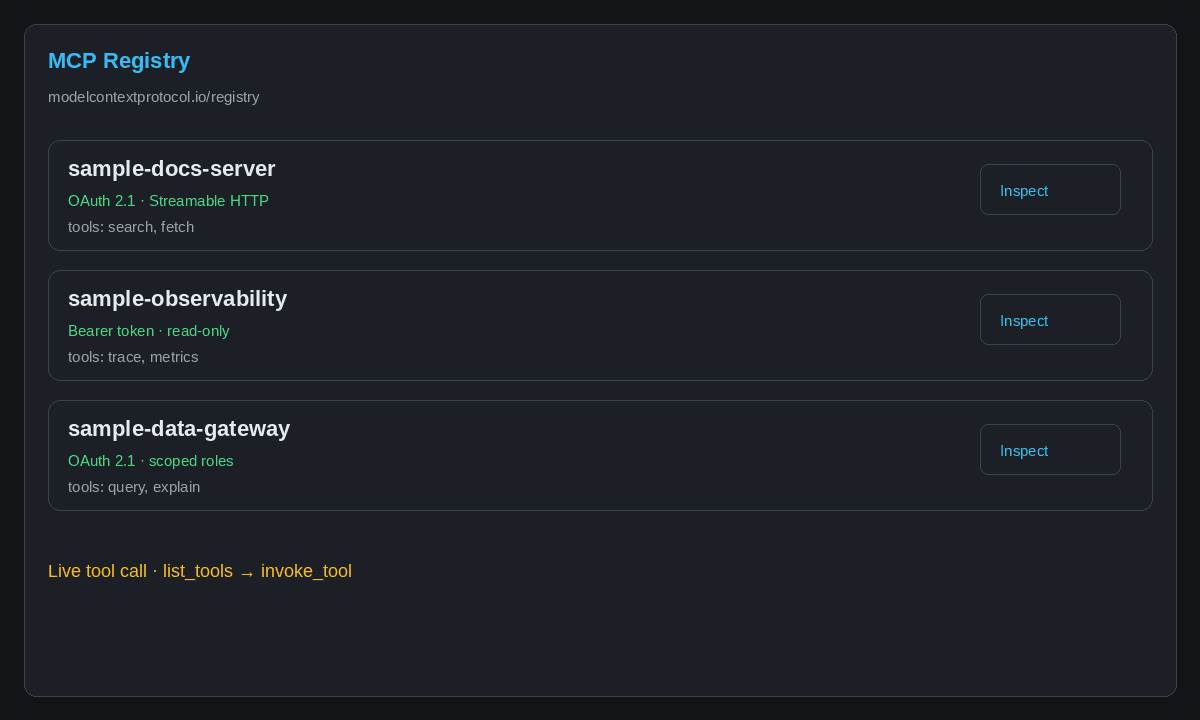
The registry tells the real story: 9,652 latest-version server records, 86,148 GitHub stars on the core repo — genuine ecosystem velocity. And then: only 8.5% of those servers implement OAuth 2.1. The spec has been mandatory for remote servers since March 2025. The community just hasn't built the tooling to make OAuth as easy as pasting an API key. Until it does, production MCP deployments live in the gap between a well-designed protocol and an ecosystem that hasn't caught up to it.
The MCP Mental Model: Transport, Primitives, Lifecycle
MCP solves the N×M integration problem: before it, each AI tool needed a custom connector to each data source. One server implementation now serves all compatible clients — Claude, ChatGPT, Gemini, Cursor, Copilot — without modification.
The protocol is built on five primitives:
| Primitive | Role |
|---|---|
| Tools | Executable functions the LLM invokes, defined in JSON Schema |
| Resources | Context data (files, DB records, API responses) |
| Prompts | Server-provided prompt templates |
| Tasks (extension, 2025-11-25+) | Call-now, fetch-later async pattern — returns a handle, client polls |
| Elicitation | Server pauses execution to request user input (OAuth flows, structured clarification) |
graph LR
    subgraph Clients
        CC["Claude"]
        CGT["ChatGPT"]
        GEM["Gemini"]
        CUR["Cursor"]
    end
    subgraph MCP["MCP Server\n(one implementation)"]
        TOOLS["Tools"]
        RES["Resources"]
        PROMPTS["Prompts"]
    end
    subgraph Data["Data Sources"]
        DB["Database"]
        FS["File System"]
        API["Internal APIs"]
    end
    CC --> MCP
    CGT --> MCP
    GEM --> MCP
    CUR --> MCP
    MCP --> DB
    MCP --> FS
    MCP --> API
Transport in 2026: Streamable HTTP is the production standard for remote servers. The release candidate locked May 21, 2026 eliminates the protocol-level session entirely — Mcp-Session-Id header gone, any request routes to any instance, tools/list responses are cacheable. Local process servers still use STDIO.
Lifecycle: The client discovers the server via the registry or a config file, negotiates capabilities, then routes tool calls as JSON-RPC requests. Version identifiers are date-stamped strings (2025-11-25, 2026-07-28) — not semver. Clients must handle version mismatches gracefully; the forthcoming spec formalizes a deprecation policy with explicit windows.
Production Patterns: Auth, Orchestration, Observability
Auth: implement it now, before your security team asks
The spec mandates OAuth 2.1 with PKCE for all remote servers. The 2026-07-28 RC hardens this with RFC 9207 iss validation to prevent mix-up attacks — the dominant class of OAuth implementation bug in multi-server deployments.
In practice: don't implement OAuth from scratch. The MCP Authorization spec is a multi-month project if you wire Dynamic Client Registration, Authorization Server Metadata, and token chaining yourself. Delegate to an existing identity provider — Auth0, Okta, Keycloak — and wire MCP as a Resource Server. The integration is thin; the IDP handles the heavy lifting. Claude MCP Mastery walks through the full OAuth wire-up with working client and server code.
For internal-only servers (STDIO or behind an internal network boundary), API keys are acceptable as a stepping-stone, but rotate them on a schedule and treat them as credentials, not config.
Multi-server orchestration: tool budgets are your real constraint
Loading five servers with 12 tools each burns 30,000–75,000 tokens before the user sends a single message. The community label for this is "context rot" — the model's attention dilutes across tool schemas, causing hallucinated tool arguments and forgotten objectives.
The pattern that works: progressive disclosure (Code Mode). Present the server as a code API at initialization; load tool definitions on-demand when a semantic trigger fires. Cloudflare reported 98% token savings — one workflow dropped from 150,000 tokens to 2,000.
For orchestration across multiple servers, assign tool namespaces per server and route subagents with narrow tool sets rather than giving a single model all servers simultaneously.
Observability: the spec doesn't define it — you have to
There is no standardized audit trail in the current spec. Enterprise deployments are building their own SIEM and APM integrations. What to instrument:
- Tool call trace: server → tool name → arguments (redacted) → response latency → token cost
- Auth events: token acquisition, refresh, and failure — your first signal for auth drift
- Context budget per session: tokens consumed by tool definitions vs. task content
- Version mismatches: log client-reported protocol version vs. server-advertised version on every connection
Langfuse and Helicone both ingest MCP call traces via their standard OpenTelemetry SDK integrations. Wire these at the server boundary, not inside tool handlers — you want the trace even when a tool throws.
Version compatibility
The upcoming 2026-07-28 spec eliminates protocol-level sessions. If you have servers in production on 2025-11-25, plan migration before the spec ships in late July. The breaking changes:
- Remove any sticky-session logic — the new spec is explicitly incompatible with session-dependent state at the transport layer
- Implement the explicit-handle pattern: servers mint an opaque handle (e.g.,
basket_id,task_id) from a tool call; the model passes it as an ordinary argument in subsequent calls - Update your
tools/listresponse to includettlMscache hints where safe
The official Python and TypeScript SDKs are expected to ship 2026-07-28 support within the ten-week validation window — by early August. For a preview of what comes after the 2026-07-28 freeze, see MCP 2026 Roadmap Explained.
5 MCP Servers We Actually Run in Production at Koenig
We run the Koenig AI Academy on a Paperclip multi-agent system. Here are the five MCP servers that survive contact with production:
1. Filesystem MCP — vault reads and writes. Every blog draft, research note, and course chapter flows through this. We scope it to vault/ only via an allowlist and run it as a local STDIO process. No auth surface, no network exposure.
2. GitHub MCP — PR creation, issue management, and file push for the content pipeline. We authenticate via a scoped Personal Access Token (not OAuth — the GitHub App OAuth dance was not worth the ops overhead for an internal server). Token rotation on 90-day schedule.
3. Tavily MCP — live web research and fact-checking. Remote server over Streamable HTTP. This is the only server where we pay the OAuth tax: Tavily's API key lives in our secrets manager, rotated monthly, and the call trace goes to Langfuse.
4. Paperclip Task API MCP — internal task management. Agents read issue state, post comments, and flip statuses through a thin MCP wrapper over our REST API. Auth via a short-lived JWT issued by the Paperclip control plane.
5. Custom Obsidian Vault MCP — cross-references and wikilink resolution. Before we had this, agents hallucinated [[wikilinks]] to files that didn't exist. The server exposes a resolve_link tool that validates paths against the actual vault tree. Zero external auth surface; STDIO-only.
What we don't run: anything that gives an agent write access to production databases or external APIs unless it goes through a human-in-the-loop approval gate first.
Common Failure Modes
1. Context window explosion (most common)
Five servers × 12 tools = 60 tool schemas × ~800 tokens each = ~48,000 tokens before the task. Use progressive disclosure. Do not load all servers at startup.
2. STDIO RCE via unsafe defaults (April 2026 — CVE cluster)
OX Security disclosed a "by design" flaw in STDIO transport: the command field in MCP config allows arbitrary OS command execution if unsanitized. Ten CVEs were filed across popular frameworks including Windsurf, LiteLLM, and LangChain-Chatchat. Anthropic confirmed the behavior as intentional — sanitization is the developer's responsibility. In practice: validate and allowlist every command value at config parse time, not at execution time.
3. Tool poisoning and rug pulls
Malicious tool descriptions embed adversarial instructions visible to the LLM but not to the user. Rug-pull servers pass initial review with benign tools, then serve malicious capabilities on subsequent calls. A fake Oura ring MCP integration distributed malware before detection in February 2026. Mitigation: pin server versions and verify source hashes on every deploy; use mpak.dev's MTF score as a filter for third-party servers. For a hands-on treatment of supply-chain attack patterns in AI agent systems, see AI Agent Security for Developers.
4. Auth drift
Static API keys that were "temporary" for six months. Token rotation schedules that expire without an alert. OAuth tokens that outlive the scope they were issued for. Instrument every auth event; set calendar alerts for key expiry. Auth drift is the failure mode that manifests as a 3am incident after a six-month quiet period.
5. Registry typosquatting
OX Security cloned `mcp-server-postgres` as mcp-server-postgress (double 's') with a hidden postinstall payload that exfiltrated ~/.ssh/id_rsa. 9 of 11 MCP directories published it without automated review. Pin your dependencies, run npm audit, and cross-check package names character by character before onboarding any registry server. Full registry vetting criteria are covered in MCP Server Registry Security.
When MCP Is Overkill
MCP adds a service, a network boundary, an auth surface, and a versioning contract. That's the right trade-off when many clients need the same integration. It's the wrong trade-off when:
Use a direct SDK tool instead when: - Only one AI client will ever call this integration - The data is static (belongs in a RAG pipeline, not a live server) - The team lacks the infrastructure to monitor an additional service - The integration is a prototype — register a plain function tool, ship it, revisit if it scales
Use OpenAPI integration when: - You already own a well-documented REST API and the client is a single model - The overhead of running a separate MCP server process is not justified - Speed-to-prototype matters more than cross-client reuse
Use LangChain or Anthropic SDK function tools when: - You need Python-native logic, complex error handling, or access to local process state that would be awkward to serialize over JSON-RPC - The tool is tightly coupled to the agent's reasoning loop and doesn't benefit from the server/client boundary MCP provides
The pattern to avoid: wrapping a simple CRUD API in an MCP server because it feels more "AI-native." The USB-C metaphor is accurate — but you don't use a USB hub to charge one device.
Runnable Example: Minimal Production-Ready Python MCP Server
# requirements: mcp>=1.27.1  (pip install mcp)
from mcp.server import Server
from mcp.server.models import InitializationOptions
from mcp.server.stdio import stdio_server
from mcp.types import Tool, TextContent
import mcp.types as types

app = Server("vault-search")

VAULT_ROOT = "/vault/research"

@app.list_tools()
async def list_tools() -> list[Tool]:
    return [
        Tool(
            name="search_vault",
            description="Full-text search across the research vault. Returns matching file paths and 3-line excerpts.",
            inputSchema={
                "type": "object",
                "properties": {
                    "query": {"type": "string", "description": "Search term"},
                    "limit": {"type": "integer", "default": 5, "maximum": 20},
                },
                "required": ["query"],
            },
        )
    ]

@app.call_tool()
async def call_tool(name: str, arguments: dict) -> list[types.TextContent]:
    if name != "search_vault":
        raise ValueError(f"Unknown tool: {name}")

    query = arguments["query"]
    limit = arguments.get("limit", 5)

    # Real impl would use ripgrep or a search index here
    results = [f"vault/research/synthesis/{query}-2026-06.md — line 1 excerpt"][:limit]
    return [TextContent(type="text", text="\n".join(results))]

async def main():
    async with stdio_server() as (read_stream, write_stream):
        await app.run(
            read_stream,
            write_stream,
            InitializationOptions(
                server_name="vault-search",
                server_version="0.1.0",
                capabilities=app.get_capabilities(
                    notification_options=None, experimental_capabilities={}
                ),
            ),
        )

if __name__ == "__main__":
    import asyncio
    asyncio.run(main())
Expected output when called from Claude Code:
Tool: search_vault({query: "mcp production"})
→ vault/research/synthesis/mcp-production-2026-06.md — line 1 excerpt
Wire this into your Claude Code config at .claude/settings.json:
{
  "mcpServers": {
    "vault-search": {
      "command": "python3",
      "args": ["/path/to/server.py"]
    }
  }
}
KnowledgeCheck
What percentage of servers in the official MCP registry implement OAuth 2.1, and what is the primary reason for the gap?
<details> <summary>Answer</summary>
8.5% as of March 2026. The gap is a tooling problem, not a spec problem — OAuth 2.1 with PKCE, Dynamic Client Registration, and Authorization Server Metadata is a multi-month implementation project from scratch. Until delegating OAuth to an existing identity provider (Auth0, Okta, Keycloak) is as easy as pasting an API key, adoption will remain low.
</details>
The Bottom Line
MCP is production-ready in 2026 — with caveats that are all solvable. The 2026-07-28 spec's stateless core eliminates the load balancer problem. The Linux Foundation governance (Anthropic + OpenAI + Google + Microsoft + AWS + Cloudflare) removes single-vendor risk. The 41% production adoption rate (Stacklok) confirms it's past the early-adopter phase.
The gap — 8.5% OAuth, 40+ CVEs in four months, no standardized audit trail — is real but not fatal. It's the predictable shape of a protocol that moved faster than its ecosystem's security tooling. Bridge it with: auth delegated to an IDP, progressive tool disclosure for context budgets, a per-server sandbox, and instrumented traces from day one.
The servers that survive production aren't the most feature-rich ones in the registry. They're the ones with a narrow scope, pinned versions, and someone on call who knows what "auth drift" means.
Ready to build MCP servers that hold up past day one? Start with MCP: From First Principles to Production.